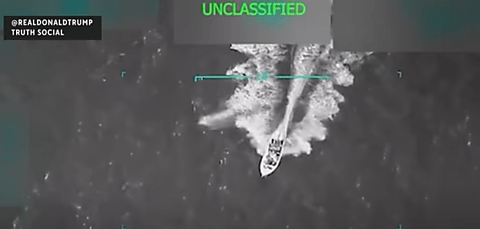
Eighty-three people are dead. So far this fall, US military forces have struck 22 suspected drug-trafficking vessels in the Caribbean, killing dozens in what the Trump administration claims is a lawful counter-narcotics operation. The most controversial incident involved a September 2 “double-tap” strike: After missiles destroyed a boat and killed most of its crew, US forces fired again on the shipwrecked survivors.
When pressed to explain the legal basis for killing people already incapacitated in the middle of the ocean in an apparent violation of domestic and international law, White House Press Secretary Karoline Leavitt reached for a prepared statement and declared that the strikes were conducted “in self-defense to protect Americans and vital United States interests.”
Self-defense? Against shipwrecked survivors of a boat that was already destroyed?
Besides its inherent implausibility, the mendacity of this explanation is further underscored by that fact that the administration has given different explanations to different audiences. To Congress, invoking the War Powers Resolution, administration officials argued that these operations don’t even rise to the level of “hostilities” because US drone operators are too far away to ever be threatened by the targeted vessels. To critics questioning the second strike, they’ve variously claimed that it was about removing “navigation hazards” or that the attacks were always intended to be lethal.
As former federal prosecutor Andrew McCarthy recently observed, the Trump administration often “just says stuff”—rotating through whatever justification seems convenient for each audience, with “no discernible concern about being consistent with what has previously been represented.”
Unfortunately, this is nothing new. Government officials regularly lie about all sorts of things—big, small, here, there, and everywhere. Perhaps such dishonesty is rooted in politics itself; political actors regularly have motivations and pursue goals that have little or nothing to do with the public interest, and they therefore have incentives to elide truth and transparency.
By contrast, the judicial branch—and, more generally, our system of law—is supposed to detect and deter official dishonesty and corruption. But modern trends in the law encourage the opposite. We now are governed by a system in which public officials are not just permitted but encouraged by judges to lie about their goals and motivations across a whole spectrum of issues and policies. That may sound like hyperbole, but it’s not.
The fundamental driver of this problem is that the very nature of judicial review has mutated over the last century. That doctrinal change has had immense legal, political, intellectual, and cultural consequences. It has sowed the seeds of a terrible harvest.
The Supreme Court’s Two-Tiered Framework for Judicial Review
As I have explained elsewhere, including in book form, the Supreme Court has created a two-tiered framework for deciding legal challenges to the exercise of government power. When certain favored or “fundamental” rights are at stake—free speech, for instance, or equal treatment regardless of race—courts apply some form of “heightened scrutiny,” which entails a sincere effort to ascertain what ends the government is actually pursuing and how carefully in comparison to the constitutional or other legal values at stake. In these cases, judges demand, and critically assess, evidence. They require honest explanations for discriminatory or freedom-restricting policies, and they require the government to demonstrate that its chosen means are appropriately tailored to the ends it is actually pursuing. In short, facts matter, including facts about why the government is enforcing the challenged law or policy.
But for everything else—economic regulations, occupational licensing, property restrictions, and even access to potentially lifesaving experimental treatments for terminally ill cancer patients—courts apply the so-called “rational basis review.” And this is where constitutional adjudication takes a system-wrecking turn into institutionalized dishonesty.
Under rational basis review, the Supreme Court has held that the government’s actual purposes—that is, the ends it is actually pursuing with any given freedom-restricting policy—are “entirely irrelevant” for purposes of deciding constitutional challenges to those policies. Instead of determining what the government is really trying to accomplish, judges ask only whether they can “conceive” of some hypothetically legitimate end the government could, purely theoretically, be pursuing in some essentially fictional and idealized universe. Accordingly, the government “has no obligation to produce evidence” in rational basis cases and may assert justifications for its actions, for which there is no evidence and which are in fact palpably false. Thus, courts may base decisions on “rational speculation unsupported by evidence or empirical data,” and the proffered justifications need not bear any real relationship to what ends the government is actually pursuing.
Just how absurd can this standard become? Consider this actual exchange during a 2005 Ninth Circuit argument, during which Judge William Fletcher, seeking to explore the outer boundaries of the rational basis test’s conceivable-justification framework, asked the Department of Justice (DOJ) lawyer defending the challenged regulation a hypothetical:
Judge Fletcher: “Is it conceivable that space aliens are visiting this planet in invisible and undetectable craft?”
DOJ Lawyer: “Yes, it’s conceivable.”
Judge Fletcher: “And that would be a basis for sustaining congressional legislation, if the person sponsoring the bill said, ‘Space aliens are visiting us in invisible and undetectable craft, and that’s the basis for my legislation,’ we can’t touch it?”
DOJ Lawyer: “Your Honor, I think if Congress made a finding of that sort, it would not be appropriate for this Court to second guess that.”
Judge Fletcher: “Okay, in other words, ‘conceivable’ is ‘any piece of nonsense is enough.’”
The DOJ lawyer tried to backtrack, insisting the standard is “not completely unbounded.” But Judge Fletcher cut through the pretense: “How can you say it’s not completely unbounded when you agreed with my absolutely preposterous example?”
Although this may seem like a parody, it’s not; this is a perfectly accurate snapshot of rational basis review in action—grotesque and incomprehensible as it may seem to the uninitiated.
Permission to Deceive
As a constitutional litigator who has spent decades challenging protectionist economic regulations, I’ve seen up close and personal the mendacious permission structure established by rational basis review. For example, government lawyers defending Louisiana’s occupational licensing requirement for florists (yes, florists) creatively theorized about grave dangers from infected dirt, broken wires, and exposed floral picks—despite zero evidence of anyone ever being injured in the 49 states with no licensing requirement.
I could offer countless other examples, ranging from nakedly anti-competitive restrictions on who may sell caskets to how much irrelevant training the government can mandate just to braid other people’s hair for money. The common thread, besides judges rubber-stamping freedom-restricting laws with no real engagement or analysis, is government lawyers offering demonstrably false justifications for the policies at issue.
From Casket Sales to Body Counts
For years, critics warned that normalizing governmental dishonesty in “low-stakes” licensing cases would eventually corrupt how government approaches higher-stakes legal questions. When you teach an entire generation of government lawyers that truth is optional—that manufacturing factually baseless post-hoc justifications is not just acceptable but rewarded—those habits don’t stay confined to cases involving economic regulation or property rights.
And now we’re seeing the bitter harvest.
The Trump administration’s shifting explanations for its drug-interdiction strikes follow the rational-basis playbook perfectly:
Manufacturing Justifications as Needed: The administration claimed “self-defense” for press conferences, “not hostilities” for Congress, and “navigation hazards” for critics.
Ignoring Contradictions: If forces were never at risk from intact, operational boats (the War Powers argument), they obviously can’t claim “self-defense” against destroyed boat remnants.
No Concern for Consistency: Each audience gets whatever story sounds plausible, with no apparent worry that someone might compare notes.
This is rational-basis rationalization escaped from the courtroom. The same oily approach government lawyers learned in resisting challenges to occupational licensing, unequal and unfair taxation schemes, and eminent domain abuse—don’t worry about evidence or consistency, assume different forums won’t compare notes, and feel free to lie with abandon about what ends the government is actually pursuing—is now being deployed to justify lethal military force.
As McCarthy noted, if US forces conducting these strikes are supposedly operating from such safe distances that the intact boats never posed any threat (the basis for claiming no “hostilities”), then how could striking shipwrecked survivors possibly be “self-defense”? The justifications are not just inconsistent—they’re mutually exclusive.
Only the Government’s True Ends Can Justify Its Means
Some people doubt that it is possible for judges to reliably assess the government’s true ends, while others contend that this question, even if it could be answered, is irrelevant to constitutional adjudication. They’re wrong on both counts.
Consider the following illustration. Imagine police going through a given neighborhood ordering residents to stay indoors until further notice. No statute or court order authorizes this command. Is it constitutional? It turns out you can’t answer that question without asking what the cops are up to—that is, without asking why they ordered people to stay indoors. In other words, you need to know whether the cops’ mission is more like that of Boston or more like that of Birmingham:
Boston, April 2013, Hours After the Marathon Bombing: Police order residents to shelter in place while hunting armed terrorists who just killed three people. This was almost certainly constitutional—a legitimate exercise of emergency police power.
Birmingham, Alabama (Pre–Civil Rights Era), the Day Before an Election in a Predominantly Black Neighborhood: The identical order becomes patently unconstitutional—a transparent attempt at voter suppression using a “public safety” pretext.
Thus, the exact same freedom-restricting command may be constitutional or unconstitutional based solely on what end the government is actually pursuing.
The Price of Pretense
The Supreme Court ostensibly created rational basis review to show deference to democratic processes. The actual effect has been to corrupt those processes by teaching government actors that official duplicity works and that it can be an effective way to win not just in the courts of law but in the court of public opinion as well.
The cost can be measured in lost livelihoods—the aspiring florist or interior designer prevented from earning an honest living by nakedly protectionist laws upheld through governmental lies that courts eagerly rubber-stamp.
But now the cost is being measured in extrajudicial killings that appear to be war crimes or cold-blooded murders—or both. If courts accept demonstrable falsehoods from government lawyers about the licensing of florists or interior designers, why not try the same approach for justifying illegal military strikes? If “actual purposes” are “irrelevant” in most constitutional litigation, as the Supreme Court has (mistakenly, I believe) held, and if even the hypothetical existence of invisible space aliens provides a “conceivable” justification for legislation, why should consistency or truth matter in War Powers briefings?
The Supreme Court taught government lawyers that in rational basis cases, you can just make stuff up and offer judges any justification you can manage to deliver with a straight face—no matter how palpably false. Any conceivable piece of nonsense is enough. Evidence is optional. Contradictions don’t matter. When the legality of the administration’s extrajudicial killing of unarmed civilians off the Atlantic and Pacific coasts of South America ends up in court, as it surely will eventually, will government lawyers continue dissembling, or will they finally tell the truth? More to the point, will the courts even ask for the truth?
If we want government to be honest about why it’s killing people on the high seas, perhaps we should start by ensuring that courts insist on honest explanations when government restricts our freedom to earn a living or make use of our property. The rule of law cannot survive a system in which judges knowingly accept lies then express surprise when that habit metastasizes into matters of life and death.
Eighty-three people are dead, including at least two who were deliberately finished off while clinging to the wreckage of a first strike. And the legal framework that taught their killers that dishonest justifications are acceptable was normalized not by this administration but by the Supreme Court—one rational basis case at a time.